Demo: Who Shares the File Pointer
One file, two file descriptors, obtained in three different ways, and a read of four characters through each.
Goal
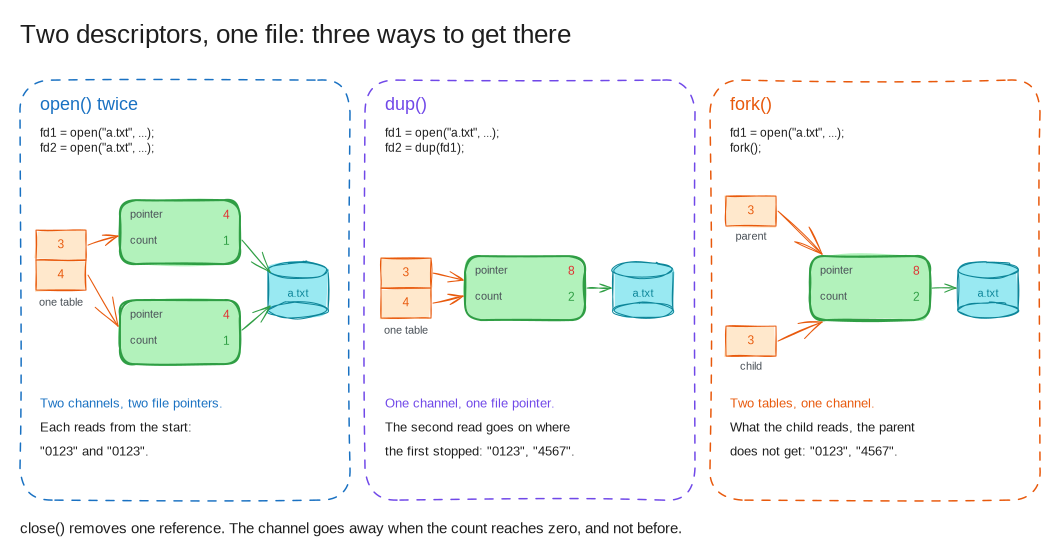
See that the file pointer belongs to the channel: two open() calls make two channels and two pointers, while dup() and fork() make a second descriptor for the same channel, and share one.
Background
file-pointer.c writes the 16 characters 0123456789abcdef to digits.txt.
Then it goes through three scenarios, and in each it reads four characters through one descriptor and four through the other.
| Scenario | How the second descriptor is obtained |
|---|---|
| 1 | open() is called a second time on the same file |
| 2 | dup(fd1): a new descriptor for what fd1 leads to |
| 3 | fork(): the child has a copy of the parent's descriptor table |
After every read the program prints the file pointer, which lseek(fd, 0, SEEK_CUR) returns without moving it.
Build and run
Results and explanations
$ ./file-pointer
1. fd1 = open(), fd2 = open(): two channels
         read(3) = "0123"   file pointer of 3 is now 4
         read(4) = "0123"   file pointer of 4 is now 4
2. fd1 = open(), fd2 = dup(fd1): one channel
         read(3) = "0123"   file pointer of 3 is now 4
         read(4) = "4567"   file pointer of 4 is now 8
  close(3)
         read(4) = "89ab"   file pointer of 4 is now 12
3. fd1 = open(), then fork(): one channel, two processes
  child  read(3) = "0123"   file pointer of 3 is now 4
  parent read(3) = "4567"   file pointer of 3 is now 8
Scenario 1.
Both reads return 0123.
Each open() made a channel of its own, with a file pointer that starts at 0, and reading through one does not move the other.
The file is the same; the two channels do not know about each other.
Scenario 2.
The second read returns 4567: it went on from where the first stopped.
dup() did not make a channel.
It made a second entry in the table that leads to the channel fd1 leads to, and there is one file pointer, in the channel, whichever number is used to reach it.
Then the program closes descriptor 3, and reads through 4 again, and gets 89ab.
The channel is still there.
It keeps a count of the entries that lead to it; close() lowers the count, and the channel is given up when the count reaches zero.
Scenario 3.
The child reads 0123, and the parent, afterwards, reads 4567.
fork() copied the table, and a copy of an entry leads where the original leads: to the same channel.
Two processes, each with a descriptor 3, and one file pointer between them.
This is not an accident of the implementation.
It is what makes (echo one; echo two) > out.txt produce two lines: both commands inherit one channel to out.txt, and the second writes where the first stopped.
If each had a pointer of its own, the second would overwrite the first.
Going further
- In scenario 1, open the second channel with
O_WRONLY, writeXXthrough it, then read through the first. Do two channels to one file see each other's data? - In scenario 3, let the parent and the child each call
open()after thefork(). What do they read? - Scenario 3 has the parent wait for the child before reading.
Remove the
wait()and let both read at once, a few thousand times in a loop. Is this a race condition, in the sense of lecture 08, and who protects the file pointer? - Run
./file-pointerunderstrace -fand find thedup()and theclone().
References
man 2 open, the paragraph on the open file description, which is what this lecture calls the I/O channelman 2 dup,man 2 fork(the paragraph on inherited file descriptors),man 2 lseek- Kerrisk, The Linux Programming Interface, section 5.4, Relationship Between File Descriptors and Open Files